Great Barrier Reef Photos And Supports The Save Our Planet Program
Our planet is indeed gasping for air at this moment. Our harmful pollutions are choking her slowly and continue to strip her of her ozone layer.
Luke is very concerned about this and the Saving Our Planet Program and feels it is time for all people to respond to this alarming state of the only planet we live in, and doing our share of protecting her by doing simple things that will surely make a big difference.
If we fail to respond, we might be harming ourselves in the years ahead as well as our children’s, for nature has a destructive way of getting back at us humans.
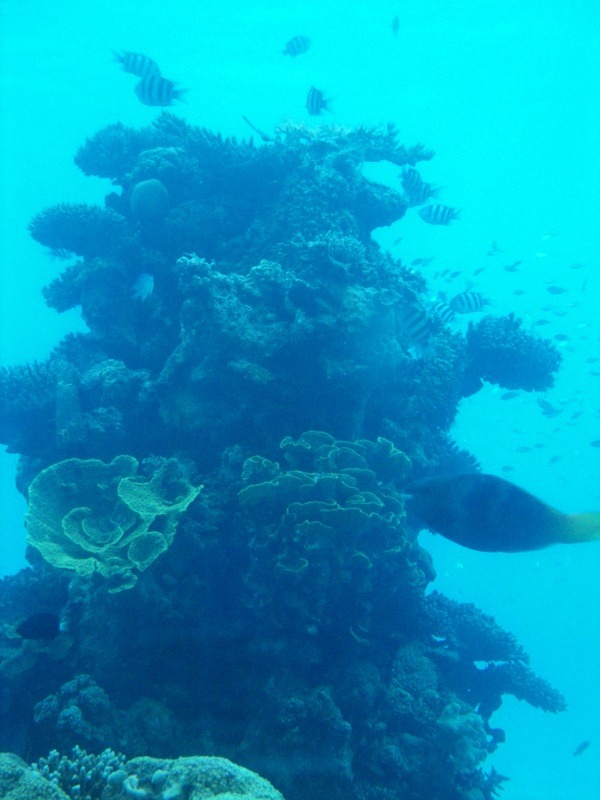
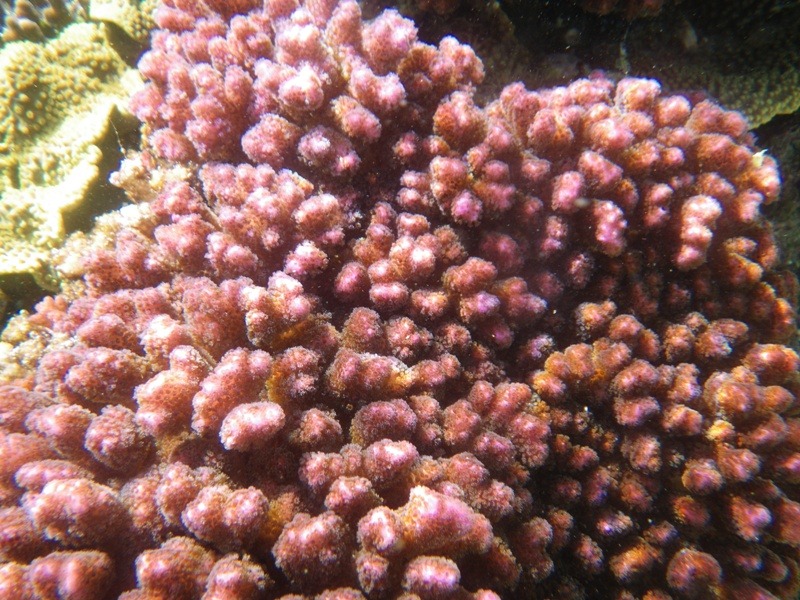
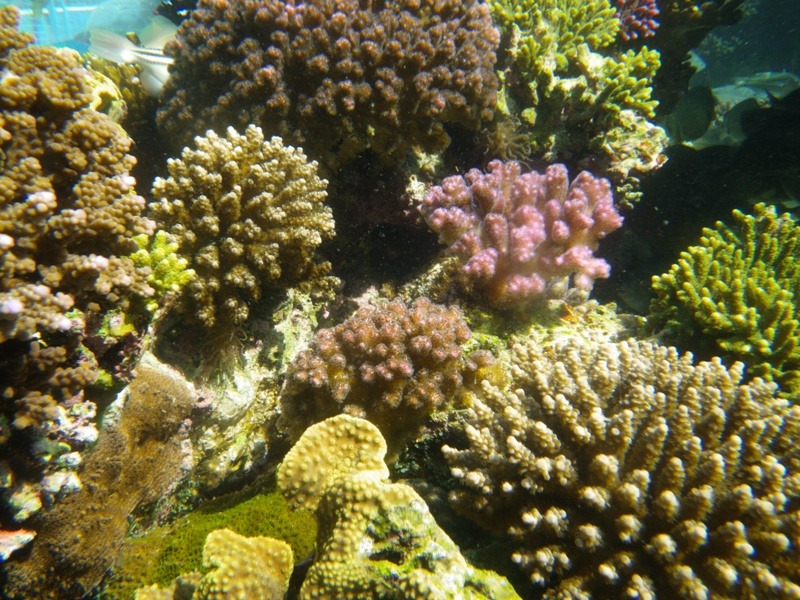
The signs of our earth's displeasure with harmful activities of humans are now seen and felt all across the globe which is now causing global warming, climate change, acid rain, drought, flash floods and other forms of natural catastrophes. Luke has recently been on a diving trip to the Great Barrier Reef and sent us some of the photos he has taken and we would like to share them with you. Reefs like this cannot be destroyed by humans; they are part of our life line.
Here are some suggestions on how we can help save our planet:
Reduce, reuse, and recycle.
Be kind to trees, they provide much oxygen.
Properly dispose of contaminants such as mercury.
Minimize the use items containing chlorofluorocarbons (CFCs) that are responsible for the climate change and depletion of our precious ozone layer.
Educate your children.
Be responsible for your garbage.
Do not burn plastic ( this aids in reducing our ozone layer).
Support environmental conservation in your area.
Luke and Peter have responded in their own words:
Luke and I have had various discussions over the years and now again over the phone. We can only suggest things like taking away Mangroves allows more sediment to be released into the Reef, along with farmlands that, with their excessive use of fertilizers release enormous amounts of nitrates & phosphates also into the reefs. Other impacts are the excessive fishing for hobby & recreational purposes. Another one that just comes to my mind, but I'm yet to see that mentioned in survey reports, as I've never seen a study result to-date, are the asphalting of roads....!!
The Storm water run offs with all the filth that comes from and on the roads would also cause an impact, IMO. Let’s see an ICP-MS spectrograph of all those
Hydrocarbons that run off into the reefs...!!
Cheers,
ORPHEK PR72 THE BEST REEF LED PENDANT FOR THE COST
The Orphek PR72 Reef , was introduced to the market at the MACNA Convention held in Dallas, Texas in September, 2012. The high PAR and coverage ability pleased all who visited the Orphek Booth.
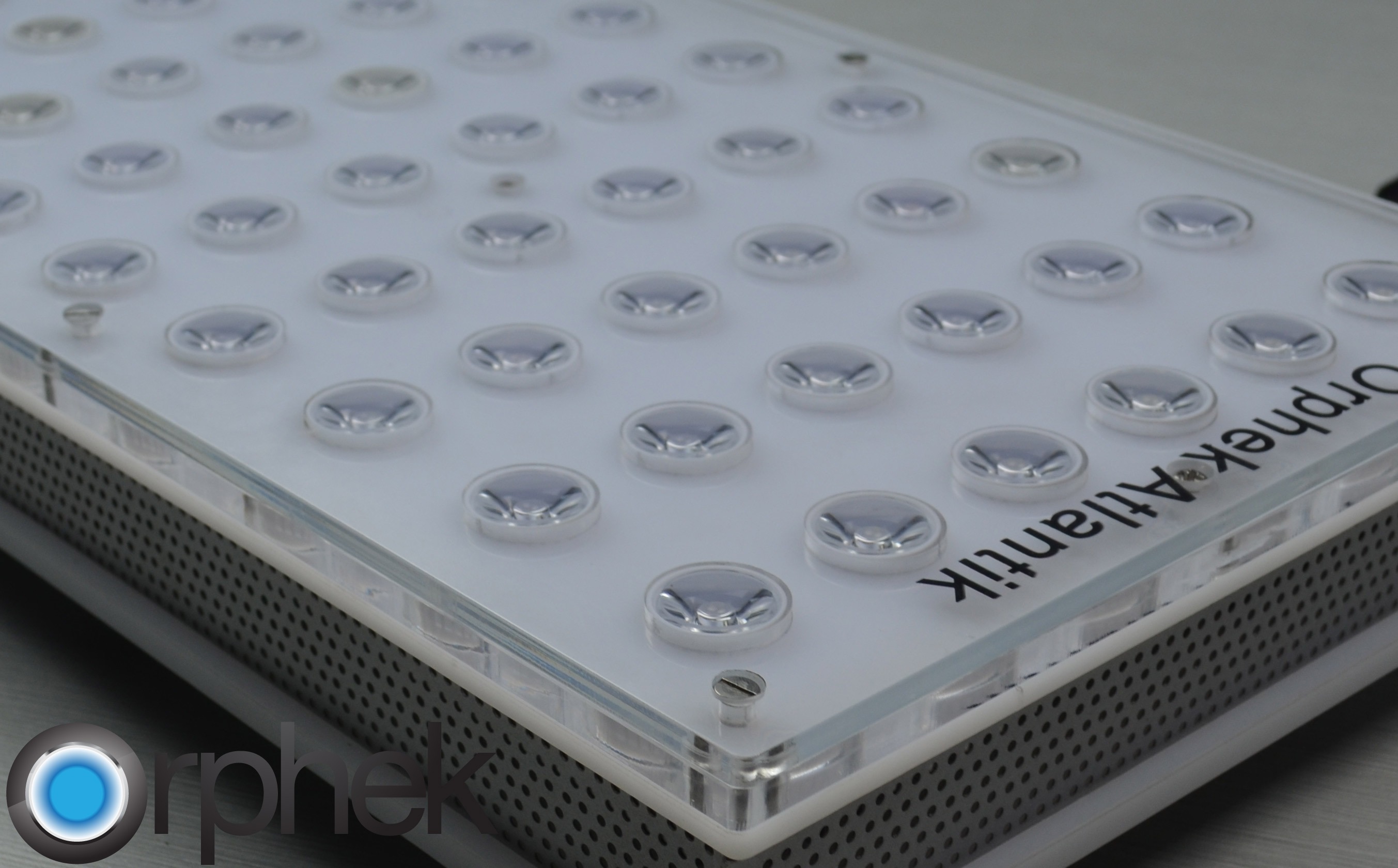
The PR72 was designed for smaller aquariums and frag tanks and for those aquarists on a limited budget who want to upgrade to LED lighting and still have the same LED technology that goes into our PR156XP and our top of the line Atlantik. Two of our PR72 Pendants will cover a 47.2" L x 23.6 " W tank with plenty of PAR in the PUR spectrum to grow all types of corals. Dollar per watt, it is the least expensive pendant on the market.
PAR readings taken at our MACNA booth impressed all who witnessed and the Kelvin temperature the PR72s rendered was very impressive. Corals and fish popped with color that no older lighting technology could provide.
Benefits
Low cost
High PAR
No fans
Remote Mean Well LED Driver
Plug and Play technology
RJ45 cord integrated into the unit to allow direct plug in to Neptune Apex controllers as well as others.
Lightweight all aluminum design.
Efficient heat sink eliminates heat into the aquarium.
Best LED technology available.
36, three watt LEDs used.
Safe high range UV and our special Orphek red LEDs installed which will give your corals and fish pop out color.
If you are looking for a high output, a low cost solution to conserve energy, as well as going green and contributing to lower the world’s carbon footprint*, you need look no further than our PR72 Reef LED Pendant.
*The majority of electricity in the world is produced by the burning of fossil fuels such as coal and oil. By lowering the amount of electricity you use, you will be contributing to lower your carbon footprint.
WHY Orphek DIF100 LED LIGHTING IS THE BEST LIGHTING FOR PUBLIC AND LARGE HOME AQUARIUMS
Orphek has been producing LED lighting for nearly five years and we are very excited about our DIF100’s capabilities for both public and large home aquariums such as Pieter’s six meter reef tank which recently has been upgraded from metal halide lighting to our DIF series of LED pendants.
There are many benefits to be realized by upgrading to Orphek DIF LED Pendants in both public and large home aquariums. The most obvious is the ability to see more of the exhibit or the display which leads to a big visual impact in seeing the corals and fish as if they were in their native habitat.
Pieter’s 1,582 gallon reef aquarium lit by Orphek DIF Series Pendants
Most public aquariums run on a tight budget which is generally funded by admission charges to the patrons so saving money is always a priority. A considerable amount of savings comes from much less energy being used and the elimination of yearly lamp replacement which also adds to maintenance time.
Many public aquariums and institutions are going green in an effort to lower their carbon footprint and the Orphek DIF Pendants will do that for you.
DIF 100 aquarium Led lighting by orphek
The savings realized will quickly pay for the investment in an Orphek LED upgrade. Another benefit is that the amount of lamps required to light a given area is reduced with Orphek DIF Series Pendants which makes for a cleaner uncluttered look and making maintenance chores much easier.
For live coral displays, our DIF 100 Pendants excel at providing the necessary intensity (PAR) and spectrum to grow corals even at depths of up to four feet.
Our wide range of available Kelvin temperatures allows the DIF Series of Pendants to be configured for a variety of uses including freshwater displays. Kelvin temperatures are available from 7,000K to 25,000K.
With a choice of four different high quality optical focusing lenses to choose from, the DIF Pendants can be used for a variety of different depth ranges as well as tailoring the light spread for a specific display size.
If you are a curator of a public aquarium, or have a large home aquarium and want to save money on energy and maintenance costs and improve the visibility of your display as well as the color of your inhabitants, please contact us for more information on how we can help you greatly reduce your operating costs.
For more information or a quote, please contact us at
WHY ORPHEK ATLANTIK EXCELLS AS THE BEST LED AQUARIUM LIGHT
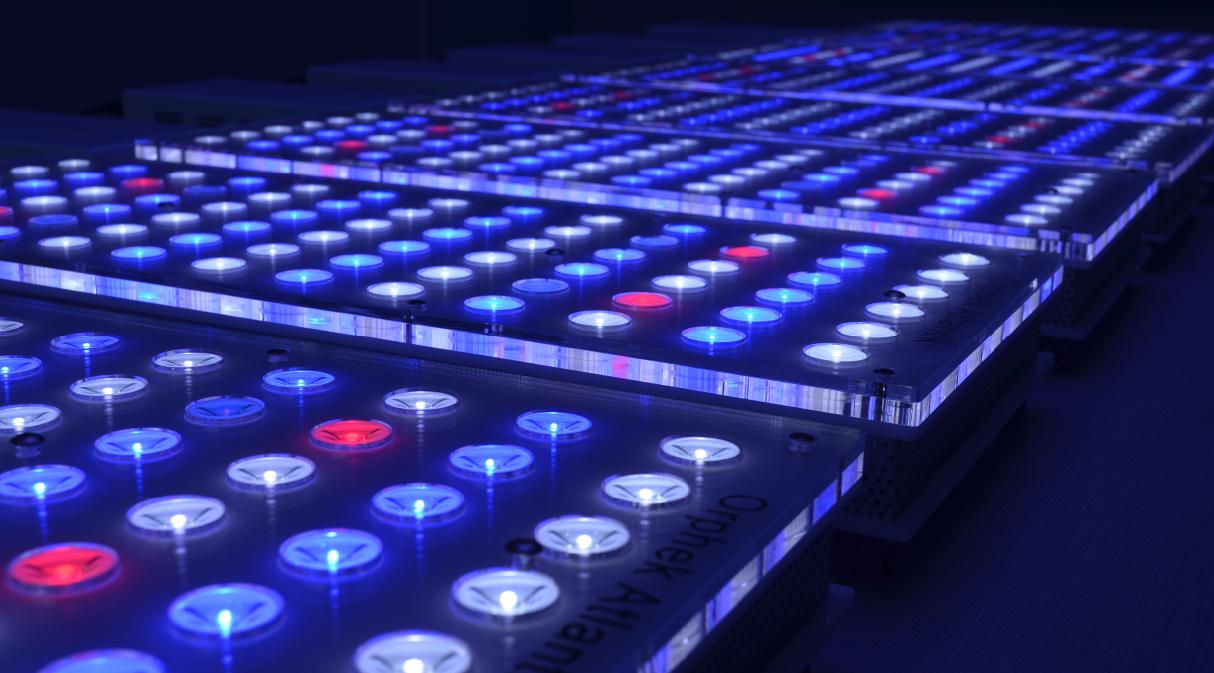
At the MACNA 2012 Marine Conference held in Dallas, Texas, Orphek unveiled its new Atlantik Four Channel Programmable LED Pendant which proved to be a huge success with reef aquarists. A testament to this lies in the fact that our first production run of the Atlantik were completely sold out during the few days of its availability.
Orphek’s design goals for our new Atlantik were:
Provide the highest PAR per watt.
Provide high Kelvin temperature using a minimal amount of blue LEDs by using our proprietary 17K white LEDs.
Provide easy programming.
Provide eight pre-programmed photoperiods for different applications.
Provide high PAR for tanks over 36 inches deep.
Provide useful features; no gimmickries like storm modes, disco effects, or useless green or yellow LEDs that add cost to the fixture, lower the PUR spectrum and provide no useful benefit to corals.
Provide whisper quite cooling fans to eliminate heat thereby extending the life of the electronics.
Provide high quality optical lenses so a minimum amount of pendants are needed on large aquariums.
Provide high efficiency industrial grade LED drivers.
Provide the best PAR/PUR per dollar.
Orphek engineers have met or exceeded all the goals that were set and we now have what we feel is the best reef LED pendant available for the price. Our high intensity LEDs were demonstrated with a PAR meter at the recent MACNA conference which resulted in quite a few woos and ahs. A short video can be seen here which demonstrates this.
Orphek did not stop with the above goals, the Atlantik also includes eight pre-programmed photoperiods which will allow new users to select a program based on their needs so that they can get their Atlantik up and running while learning how to program their own photoperiod, or they can simply use one of our pre-programmed photoperiods suited to their application. Our Coral Acclimation program is very useful as it allows your corals to adjust to the intensity of the Atlantik without fear of coral recession due to an excessive increase in light intensity.
The Atlantik Wide Model provides high PAR/PUR at a height of 47 inches (120cm) and at a distance of 20 inches (50cm) off center for all direction. And at this height and horizontal distance, the Atlantik will still provide a PAR/PUR value sufficient. One Atlantik Wide Model will cover a ~ 48”x 30”x tank with more than enough light intensity for growing SPS corals. At the most distant location from the pendant, the PAR/PUR will still be at least ~70-80 and this is equivalent to about 160 PAR with metal halides while only using 187 watts of power. Compared to metal halide lighting that would be needed for a tank this size (two 175 watt halide lamps), there is a savings of 163watts or 1.63 kilowatt hours per day based on an average 10 hour photoperiod. That’s a savings of 595 kilowatt hours per year. This writer’s energy charges are 79 cents per kilowatt hour which would result in a yearly savings for me of $470.00 dollars, a little more than half the cost of one Atlantik shipped to the USA. Add to this savings are no lamp replacement or chiller expenses.
Our new Atlantik four channel programmable LED pendant is sure to please your wallet and your corals. A questionnaire has recently been sent out to owners of our new Atlantik and their responses can be found by following this link. As we receive their responses they will be added so keep checking our site for new entries.
ORPHEK NOW INCLUDES SELECTABLE PRE-PROGRAMMED PHOTOPERIODS IN OUR NEW ATLANTIK LED PENDANT
After four years of intensive research involving different wavelengths/spectrums, and studying how corals grow and react to them, Orphek has now released their new Atlantik Programmable Pendant. Our testing and research was not just conducted in our own coral labs but in experienced hobbyist’s tanks throughout the world.
Orphek has accumulated much information about wavelengths and intensity that have shown to be the best growth rate in corals as well as color. Much of this experimentation in our quest to provide the best LED lighting for corals was conducted using our PR156 Pendants as a platform where we could inter-change LEDs of different wavelengths and study the reaction and growth rate the corals displayed.
State of the art electronics, whisper quite fans, and excellent interfacing with the Atlantik Controller all contribute to provide the very best LED lighting for your corals. Our four years of research left no stone unturned and the results will speak for themselves.
Browse through any marine etailer’s product pages and you will find a plethora of additives and supplements all promising increased coral growth and color enhancement.
Of course many of these supplements are necessary and crucial for good coral growth and color, but we need to be aware of the fact that 90% of a corals energy source is generated by the Zooxanthellae that reside in the coral’s tissue. The Zooxanthellae depend on light of the correct intensity and spectrum to grow and flourish. This is why we at Orphek are very dedicated to providing the correct lighting spectrum and intensity necessary for good coral growth and color.
We also realize that corals must be acclimated from one light source technology to another while at the same time minimizing loss of Zooxanthellae due to spectrum and intensity changes. Recognizing this fact, we have decided to incorporate eight different pre-installed lighting programs into our Atlantik LED Pendants that can be used for various conditions and/or applications. Some of these programs are very useful and necessary for those with limited experience growing corals using high intensity LED lighting.
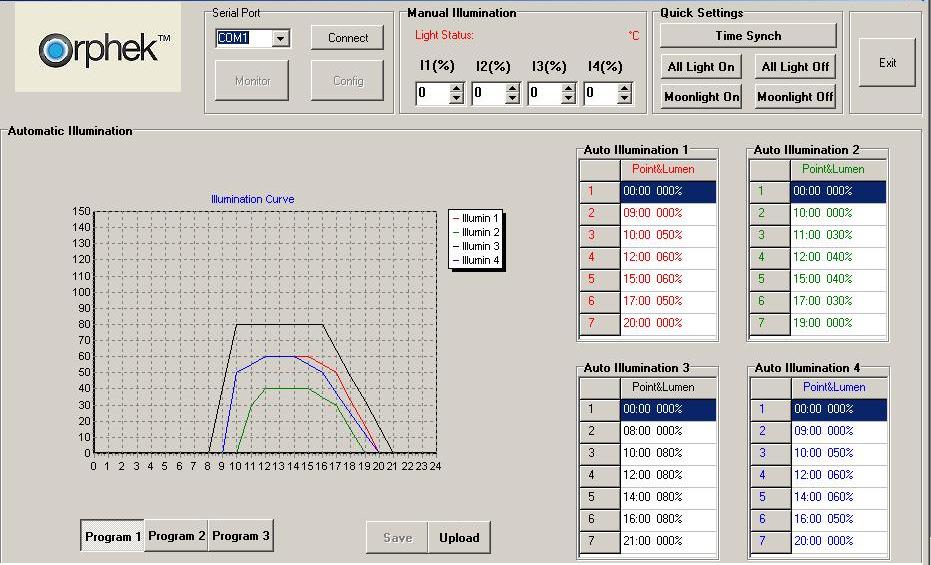
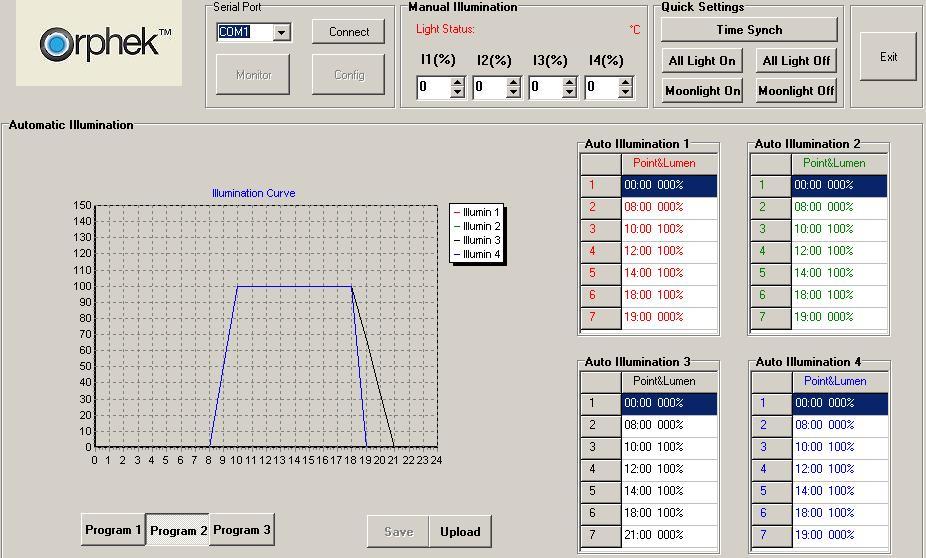
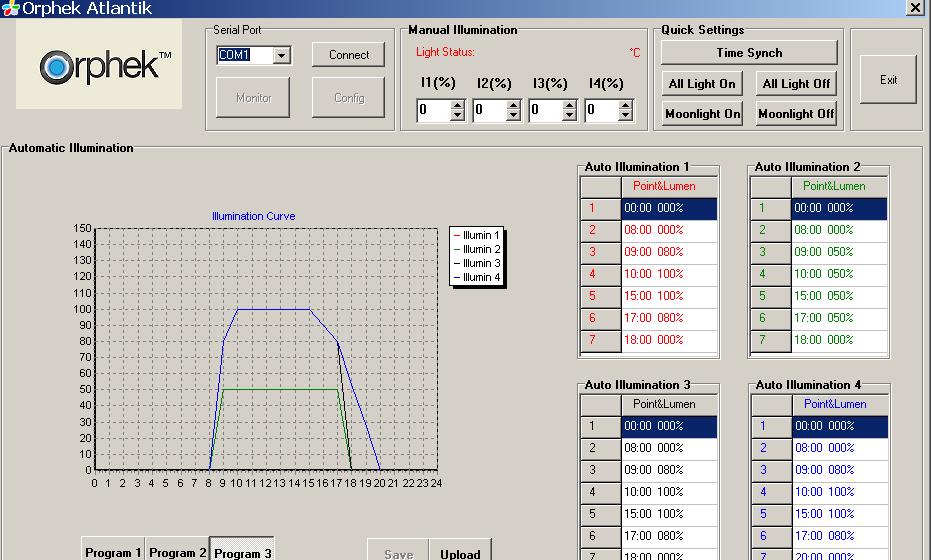
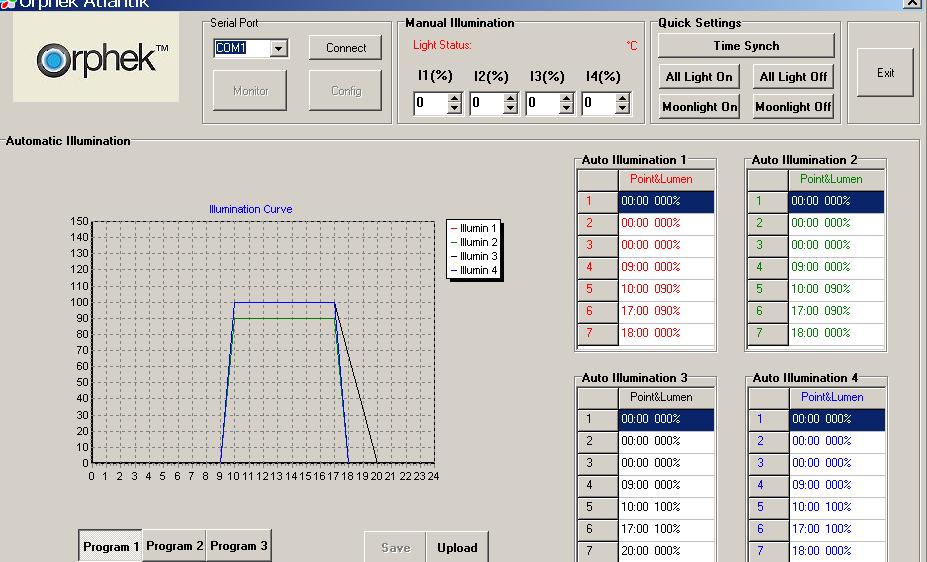
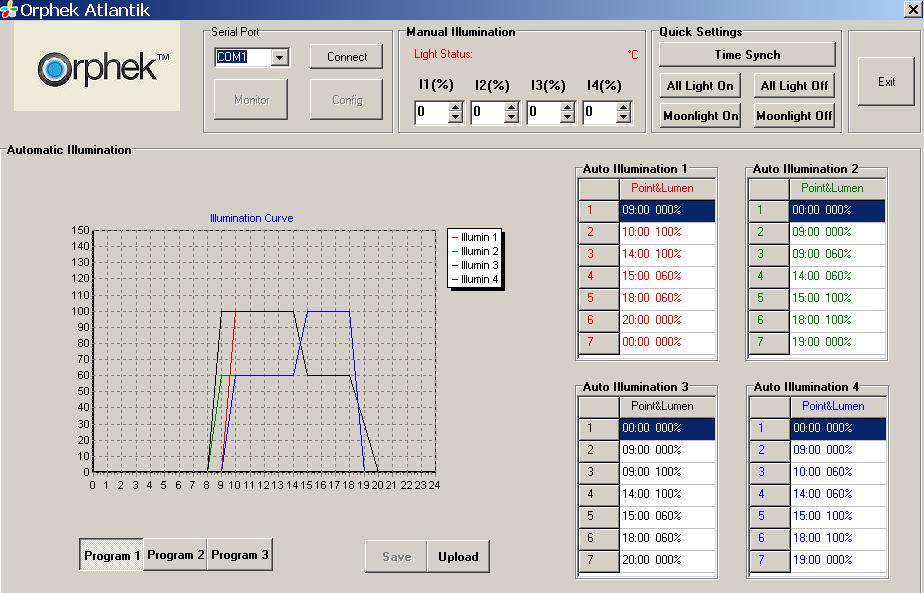
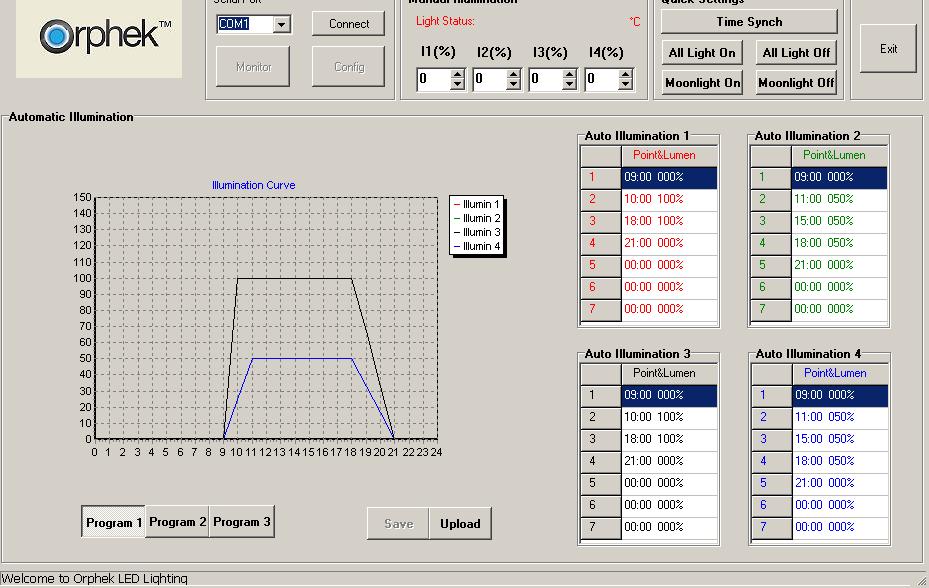
Below is a brief explanation of what each program’s intended use was designed for and the photoperiod functions displayed on the same software that is included with the Atlantik. The correlation between the data boxes under each Illumination channel and the graph are easily interpreted by color matching which makes programming the Atlantik very easy to understand and accomplish. The lighting channels on some programs may follow the same curve so each color may not be visible in the graph.
Illumination 1 controls 24 blue 460nm LEDs.
Illumination 2 is our brightest channel in the Atlantik featuring 28 high Kelvin white LEDs.
Illumination 3 is useful for night time viewing (moonlight) and also provides additional support to the 460nm blue LEDs used in Illumination 1. This channel provides eight additional 460nm blue and 4 high range UV LEDs to further stimulate coral growth.
Illumination 4 provides additional support to Illumination 2 by providing 10 white, 17,500 Kelvin LEDs and 4 red LEDs. The red LEDs stimulate Chlorophyll A and B production which is necessary for zooxanthellae growth and health.
Note: The charts below are shown to depict the photoperiod time and light intensity of all four channels of light on the pre-installed programs. Orphek does not provide software for programming on a PC.
Program 1- Slow Acclimation
Program 1 was designed to be used for coral acclimation to our high intensity Atlantik Pendant LEDs and/or for introducing new corals into your system that may have come from a different lighting technology and/or different lighting spectrum and lower intensity. Program 1 should always be used when first introducing your new Atlantik Pendant to your corals.
Program 2 – Increased Coral Growth
Program 2 was designed to increase coral growth rate and is typically used when growing frags or immature coral colonies. Illumination 2 provides occassional cloud cast simulation while the remaining channels simulate changes in spectrum intensity throughout the day which is typical on on the reefs. The cloud cast is intended to give the corals a rest throughout the photoperiod.
Program 3 – Coral Color
This program was designed to increase coral color while still providing plenty of PAR/PUR for good coral growth. When using this program be sure that magnesium, calcium, and dKH, pH and other parameters are in the ideal range and no negative conditions exist with your corals. Iron, potassium and other beneficial nutrients should also be dosed.
Calcium 430-450ppm
Magnesium – 1290-1350ppm
dKH – 8.5 – 11
pH – 8.0-8.3
Program 4 – Maintaining Accelarated Growth
This program was designed to be used after Program 2 to maintain accelerated growth and/or to be used with mature colonies. Parameters mentioned in Program 3 will also need to be maintained.
Program 5 – Coral Color + Coral Growth
Program 5 is designed to improve coral color and maintain coral growth. It provides the best of the Coral Color and Coral Growth programs.
Program 6 – Coral fragging
Program 6 was designed for shallow coral fragging systems to accelerate coral fragment growth. This is another program where coral growing water parameters must be maintained. If growing a large amount of coral fragments, dKH should be measured daily as the corals will absorb a good amount of carbonates from the water to build their skeleton.
Program 7 – Retailer Showroom Displays
Program 7 was designed for retail stores to display their corals giving them a little more irredescence making them more attractive to the buyer while still maintaining the health of the coral.
Program 8 – LPS and Soft Corals
Program 8 is designed to be used with LPS and soft corals that do not require the light intensity required by SPS corals.
You can also program several of your own photoperiods and adjust intensity of all four channels of light individually. This can be a useful feature in rooms flooded by sunlight or very dark rooms where adjustments in intensity will need to be made. It also allows you to control the lighting based on the types of corals you are keeping.
CORRECT SPECTRUM AND AMOUNT IS NEEDED FOR GOOD CORAL GROWTH
At 40 meters or less, Zooxanthellate scleractinian corals are the major specie of corals found in well-lit tropical waters where massive structures exist which provide a critical habitat for the diverse abundance of reef fish and invertebrates.
Coral structures change considerably with increasing depth which causes a decrease of Zooxanthellae. Acropora, Pocillopora and Porites are almost non-existent at depths over 40 meters where the spectrum begins to rapidly drop at 500 nanometers.
Zooxanthellae have the major photosynthetic pigments chlorophyll A and chlorophyll B with chlorophyll A being greater.
This along with amino acids and various nutrients and trace elements combine and serve as major light-harvesting components which in turn provide food to the coral by means of photosynthesis. The above has been proven by a study undertaken by many scientists and is available for a fee by going here; http://www.int-res.com/journals/meps/.
On the Hawaiian Reefs coral skeletons were found to contain an average of 13.7% (μg cm−2) of chlorophyll A and 2.6% (μg cm−2) of chlorophyll B. For some unknown reason these levels are much lower in corals from the Red Sea Reefs.
There are many species of corals found at various depths on a reef and each has adapted to the spectrum and intensity present at the depth they are found. In our aquariums, deeper water corals and/or corals coming from estuaries or turbid waters where light intensity is not as high as on pristine reef waters will likely not fare well with corals being kept which require a higher intensity of light and spectral range.
This is why it is important to plan your reef carefully by choosing corals that can co-exist with the same spectrum and intensity of light. LPS corals are generally found in deeper waters or shallower turbid estuaries where many Euphyllias are found such as Elegance Corals.
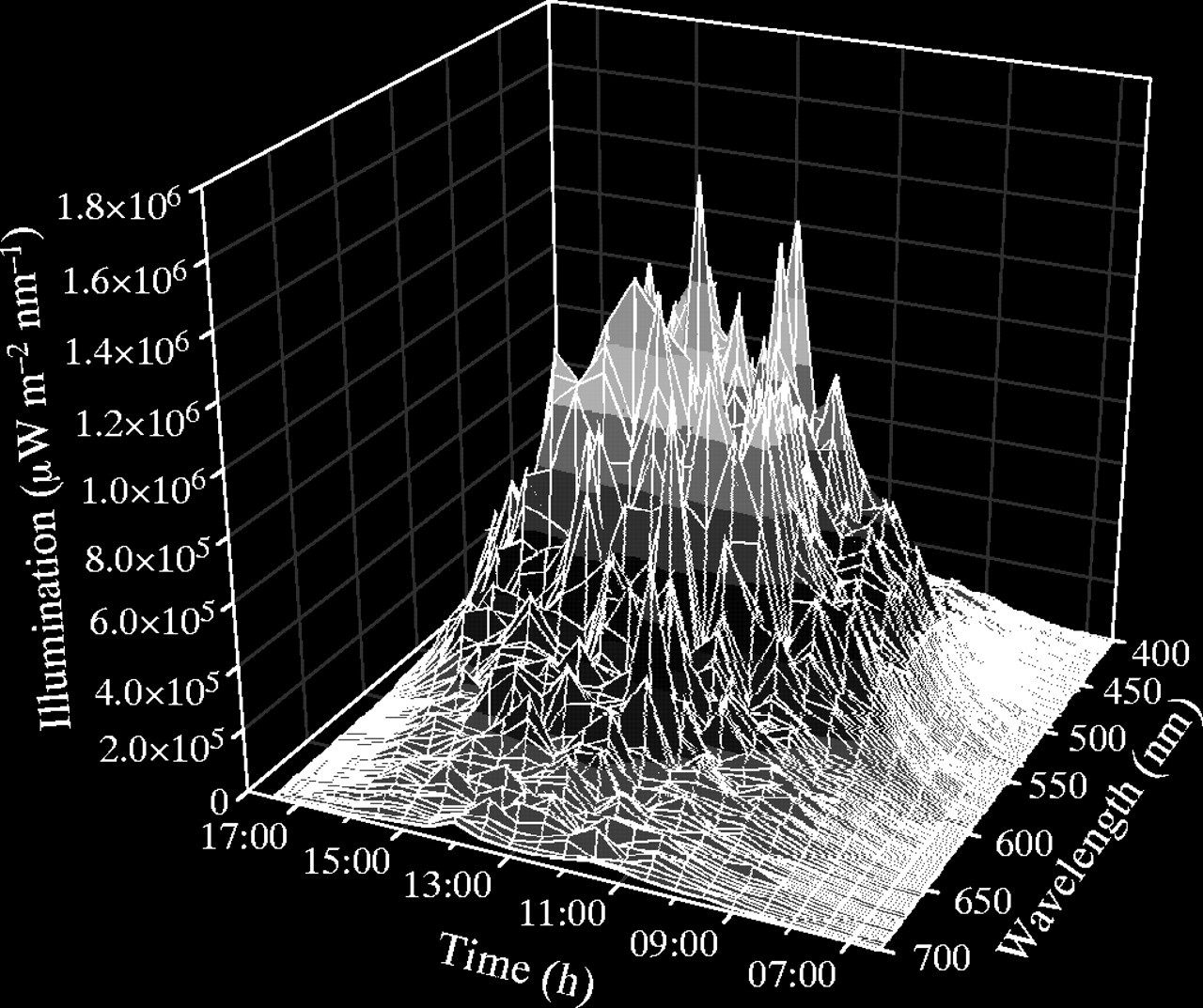
Both water depth and clarity have an effect on both intensity and spectrum. On clear well lit reefs ranging in depth from 1 to 15 meters, the spectrum is relatively flat from 375-600 nanometers at one meter and then gradually falls to about 55% of the surface irradiance. At 15 meters in depth, the wavelength falls sharply after 500 nanometers.
Some corals can gather light more efficiently than others. Thin plate corals such as plating Montiporas allow light to travel through the colony and then reflect back up from the background providing more reflectance to the corals.
What does this all mean to us reef keepers?
It means that to provide the best lighting habitat for the types of corals we choose is to keep, the spectrum and intensity (PAR/PUR) should be close to what the corals are exposed to in their native habitat.
If a mix of SPS and LPS corals is desired, care must be taken in placement so LPS corals are in an area where the light intensity is not as intense.
Experienced reef keepers generally will have either a SPS or LPS dominated aquarium which makes it much easier to regulate the light and spectrum for that particular genus of corals and greatly reduce allelopathy issues.
Our new Atlantik LED Pendant can be programmed to control both intensity and to tailor the spectrum for the coral species you intend to keep or propagate.
There are four individual channels of light and each channel provides seven different programming points which allows for a wide range of spectral and intensity options.
Based on the above, the Atlantik will allow you to program both the spectrum and intensity of the four different lighting channels to provide the most suitable light for the types of corals you will keep.
For aquarists with little reef keeping experience, the Atlantik features eight pre-programmed photoperiods with varying spectrums and intensities for different types of corals and/or applications.
Considering the high intensity of the Atlantik, Orphek highly recommends that you start with the “Slow Acclimation” program and then choose one of the more intense programs once the corals have adapted to this new light.
Once you gain some knowledge and experience with the light spectrum and intensity and how it affects corals, you can develop your own program(s) for the Atlantik. The Atlantik is capable of storing up to three programs.
Further reading is suggested and can be found here.
THE CORRECT LIGHT SPECTRUM IS IMPORTANT FOR REEF AQUARIUMS
Too often reef aquarists concentrate on providing ideal water chemistry that mimics that found on the reefs and less thought is given toward providing the ideal lighting spectrum for their corals. Water chemistry on the reef is very stable as is the light spectrum that falls on the reefs. The light spectrum will be the same whether you are 20 feet deep onFiji’s reefs or 20 feet deep onHawaii’s reefs. Duplicating the light spectrum is just as important as duplicating the water chemistry if we want our corals to grow and flourish.
To accomplish this, Orphek engineers have worked for years to provide a high Kelvin white LED to provide this spectrum in combination with UV, blue, and wide spectrum red LEDs. The difference between our lights and theirs is that we use less blue and red to achieve the spectrum corals best respond to (400-550nm, 620-700nm). With limited use of blue and red LEDs we can achieve a much higher PAR level than other fixtures provide. Blue and red LEDs emit very low lumens per watt and excessive use of these LEDs lowers the overall PAR of the LED fixture.
Because we do not use orange, yellow, or green LEDs in our systems, the spectrum that nuisance algae flourish at is virtually eliminated. We have conducted numerous experiments to back up this statement. We have proven that excessive use of red, green, and yellow LEDs lead to excessive algae growth as well as the dreaded cyanobacteria.
You can see from viewing the video how much the use of colored LEDs promotes algae growth. Many aquarists believe that the more colored LEDs there are in a fixture, the better it must be. This is very untrue and is detrimental to coral growth and reproduction as well as triggering nuisance algae growth.
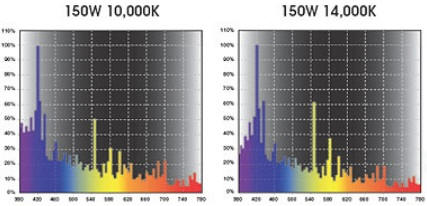
Low Kelvin white LEDs can produce the same nuisance algae growth. Many LED manufacturers will use 7,000 to 10,000K off the shelf LEDs in their fixtures and an excessive amount of blue LEDs to compensate for the yellow tinge similar to that emitted by metal halide lamps in the 7,000 to 10,000 Kelvin range. Most reef aquarists would not use lamps in this Kelvin range but freshwater aquarists would benefit their use in growing freshwater aquatic plants. So, why use low Kelvin white LEDs in reef lighting systems? Since no high Kelvin white LEDs are available, Orphek’s goal was to design and produce our own high Kelvin white LEDs in Kelvin temperatures ranging from 16,000-25,000K. What we have successfully accomplished is to provide the correct full spectral range which allowed us to use a minimal amount of blue and our special wide spectrum red LEDs. We do not use off the shelf 640 and 660nm red LEDs and use no algae promoting and PUR reducing orange, green, or yellow LEDs in any of our LED lighting systems. No other LED manufacturing company can claim this. What this does for the reef aquarist is to virtually eliminate the spectrum which nuisance algae flourish at and increase the PAR value in the PUR spectrum.
Typical 10K and 14K metal halide lamp spectrum which emits the
yellow, orange, and red spectrum. This can lead to nuisance algae growth.
Low Kelvin white LEDs can produce the same results.
Photo courtesy of Ushio Electric
Spectral curve of an Orphek LED Pendant
Multi-channel controllers
There are a few LED fixtures available, including our own Atlantik Pendant that allow different channels of light color to be independently controlled. This is fine for short periods in the early morning and late evening viewing but during the photoperiod we recommend that all channels of light be on at an equal intensity. Corals adapt to a specific spectrum and changing this throughout the day can be detrimental to the Zooxanthellae that provide the majority of their food. The effect may look cool to you but we can assure you that it’s not cool for the corals. On the reefs the spectrum never changes, just the intensity.
Our new Atlantik LED Pendant provides four channels of light which can be independently controlled. No green, yellow, or orange LEDs are used, just beneficial LEDs that promote the growth and color of the corals. Colored LEDs may enhance the coral’s color but serves no useful purpose for their growth and reduces the overall PAR/PUR level available to the corals. Yellow and green LEDs emit high lumens per watt and therefore give a higher PAR reading but the PAR level in the PUR spectrum is reduced. To learn more about spectral wavelengths and how they affect corals, please read here.
Orphek’s goal has always been to provide high PAR levels in the PUR spectrum and to promote growth of Chlorophyll A and B which further benefits the Zooxanthellae that corals depend on to live and grow.
Orphek LED lighting provides high PAR/PUR, low energy use, no nuisance algae, and no heat. What’s not to love about it?
Our new Atlantik LED Pendant is excelling in all fields of LED technology including spectral quality, features, and exceedingly high PAR/PUR levels. At present, no other LED lighting manufacturer has produced a LED Pendant that exceeds the PAR/PUR level of our Atlantik.
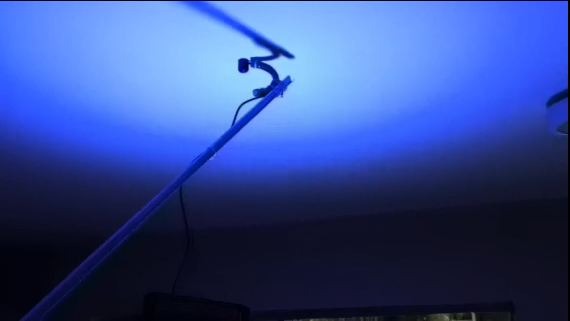
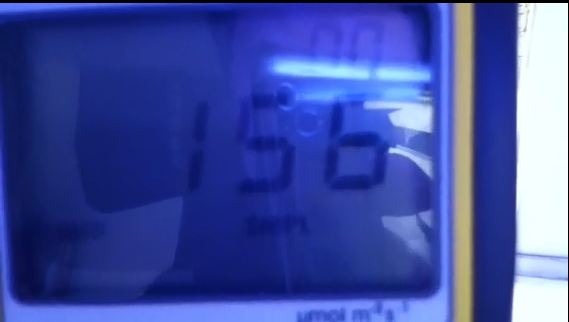
The Apogee Quantum Sensor was placed 2.4 meters (7.87 feet) above the Atlantik Pendant.
Not too many people have a tank 7+ feet deep but Orphek wanted to prove that their new Atlantik could easily light deep tanks with the PAR/PUR needed for growing all photosynthetic corals.
As you can see, the results were astonishing, a PAR reading of 156 which is enough intensity in the PUR spectrum to grow most corals.
Growing corals in very deep tanks is no longer a problem with our new Atlantik LED Pendant. One Atlantik will easily cover a 48”L x 30”W aquarium and will allow your corals to exhibit their full color and natural beauty.
Our new Atlantik features:
Models for aquariums less than 36 inches and over 36 inches in depth.
Provides wider coverage than the PR156, our previous flagship model. Two more rows of LEDs were added to increase coverage. Light output is 50% more than the PR156.
Modular in design so all components can be easily replaced by the user.
High PAR/PUR for very deep aquariums.
High efficiency LED drivers.
Will be continually improved with new software and user will be able to download newer versions from our web site as they become available.
No Atlantik will ever be obsolete.
Sunriseto sunset, dawn / dusk simulator.
Full dimming capabilities.
Ability to store three different lighting programs.
Only one controller needed if multiple units are used.
Four independent channels of lighting with unlimited control for each channel.
Full color control over all LED channels.
Mimics metal halide and T5 lighting or a combination of both.
High performance enhancement and longevity.
Eliminate the need for digital light controllers.
Orphek can provide custom LEDs for each channel of lighting if desired
Coral reefs are likely one of the harshest environments in the world in terms of the sun’s intensity and the UV/IR rays that are emitted. Metal halide and HQI lighting can produce these same effects. Although at a lower level than the sun, their emissions can still be dangerous to our coral inhabitants and our eyes without a means of filtering these rays out. This leads many reef aquarists to believe that high intensity LED lighting can also be just as dangerous to their livestock without proper filtering of these rays.
Orphek has recently conducted a test with SPS, LPS and soft corals under our LED lighting for two months to disprove any of these theories. This test involved using different spectrums with the intensity remaining the same. The test system was also supplemented with essential nutrients that corals require for good growth rate and color. During the two month test PAR was maintained at 1200 which is much higher than what most aquarists can provide in their reef systems. At no time did any of the experimental corals show any signs of stress such as recession, bleaching or loss of color. All corals continued to grow and display very good color.
There are reports from aquarists who switched to high PAR/PUR Orphek LED systems that report coral recession and/or bleaching. This in fact is not directly caused by our high intensity lighting but more so the lack of availability of nutrients needed by the corals. Orphek high PAR/PUR LEDs will trigger corals to accelerate their growth rate which in turn will exhaust necessary nutrients from the system if they are not supplemented and maintained properly.
Corals need more than a proper light source and calcium to grow and exhibit stunning color. They also require magnesium and carbonates to develop new skeletal growth. These three elements are the foundation blocks for all stony corals and must be maintained.
Calcium: 430-460ppm
Magnesium: 1290-1380ppm
Carbonates: 9-12dKH
These three foundation blocks alone, although necessary, will not allow corals to exhibit their full color and allow for rapid growth. Other elements are also required to sustain a healthy colorful coral reef. Our coral care supplementation program consists of the following:
Iodine, Bromine, and Fluorine are halogens that act as both antioxidants and oxidative agents which reduce coral bleaching. Because of their high oxidative abilities they are depleted quickly and must be supplemented on a regular basis. Iodine is also very useful for clams and invertebrates with exoskeletons.
Potassium and Boron play an essential role in the transportation of coral nutrients within the coral’s tissue and this also includes the nutrients that are provided by the Zooxanthellae. These two elements also help with the formation of aragonite in the coral skeleton.
Manganese, Cobalt, Copper, Aluminum, Zinc, Chrome and Nickel are considered light metals and assist with many bio-chemical processes within the coral including respiration and production of chlorophyll. Orphek LED lighting has a profound positive effect on chlorophyll A and B reproduction and is one reason corals exhibit wonderful color under Orphek LEDs.
Carbohydrates, Amino Acids, Fatty Acids, and Protein are directly absorbed by corals and are utilized in the process of coral protein production and tissue regeneration which helps the coral to expand its surface area to better absorb nutrients.
A good vitamin complex is useful for synthesis of chromo proteins and can duplicate the marine amino acids produced by Zooxanthellae.
Do not let this list of elements intimidate you; many companies are producing these elements already mixed in the proper proportions. Red Seais one example with their new Coral Program additives which include all of the above. Above all, test for as many of these elements as possible. Overdosing iodine, potassium, iron, and strontium can be detrimental to your reef.
Conclusions and Results of Test
Photo acclimation is not required when using Orphek LED systems. Orphek uses no dangerous UV or IR emitting LEDs. Both metal halide and HQI lamps can produce dangerous levels of UV and IR, even when using protective filters. Orphek LEDs use UV and IR LEDs that are safe for all corals and invertebrates.
Light intensity in the wrong spectrum is detrimental to coral growth.
A PAR of 150-300 in the PUR spectrum is all that is needed for good coral growth.
Excessive use of green and yellow LEDs can have negative reactions with some corals and give false PAR/PUR readings.
Supplementing nutrients and trace elements are necessary for good coral growth and color.
To further back up our statements we will soon be publishing a video taken of soft, SPS, and LPS corals grown under LEDs generating a PAR of 1000. This will testify that photo acclimation is not required with our LED lighting systems and is compatible with all types of corals.
Our first post of coral color and fast growth can be read here.
Orphek’s goal is not only to provide you with high technology LED lighting required for growing colorful corals fast, but also to educate you on the subject of growing corals. We will continue to provide new information on our site as it becomes available.
Our systems provide:
No dangerous UV and IR light.
Minimal use of green and yellow LEDs which falsely increase PAR levels while providing no useful wavelength for growing corals.
No off the shelf white LEDs are used in our systems; we design our own 16K+ LEDs, the only true white LED that duplicates the Radium 20K metal halide lamp.
High PAR/PUR.
Most PAR per dollar.
Most systems are upgradable.
No wasted money on thunderstorm and disco effects or other selling gimmicks.
Orphek LEDs have remained on the market since their inception and is indicative to our success in LED technology. Our goal is to continually improve our lighting and provide the lowest cost possible to our clients. Our systems have been tested in over 1,000 different types of aquariums throughout the world. Check our photo gallery and see the results for yourself.
Do take a look at our newest LED technology, the PR72, which we believe will be our best selling pendant capable of growing corals in depths up to 38 inches. Two PR72 Pendants will cover a 48"x24"x 30" and provide a PAR reading of 150 in the corners.
CORAL COLOR and FAST GROWTH = PR72 AND WATER CHEMISTRY
The PR72 LED Pendant is one of Orphek’s latest products recently unveiled at MACNA 2012. This milestone was fueled by Orphek’s desire to produce an affordable dimmable LED pendant which would fulfill the needs of many reefkeepers without sacrificing PAR/PUR values.
The PR72 uses the same high technology LEDs found in their best selling LED pendant, the PR156. It comes equipped with a RJ45 cable that will interface with the Neptune VDM Lighting Module for no extra charge.
Using our advanced PR156 LED technology allows the PR72 to penetrate tanks 28 inches in depth with enough PAR/PUR to support all coral growth. PAR tests were carried out on the PR72 at the recent MACNA Conference in Dallas, Texas and the results were stunning
With proper calcium, dKH, magnesium and other needed water chemistry maintained; your corals will grow at a rapid pace due to the intensity of our LEDs, and the focus we place on tuning our LEDs to produce the spectral curves corals best respond to. Corals will color up faster because our high technology LED lighting triggers rapid growth of zooxanthellae which gives corals their beautiful colors and is a necessary component for their survival and growth.
One PR72 will effectively cover a 20” x 20” x 24” tank providing ideal PAR/PUR levels for all coral inhabitants.
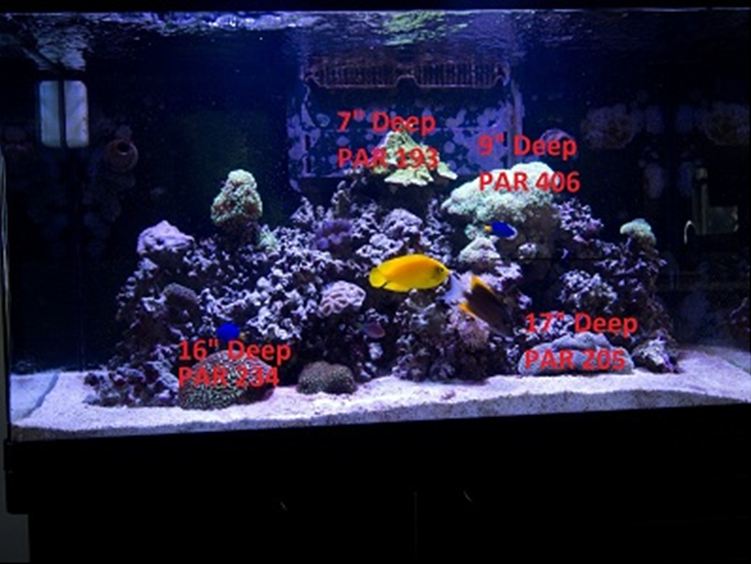
A user of our PR72s reported these PAR figures taken with an Apogee Quantum
meter and sensor. The pendants are hanging 14 ½” above the water surface and
produced a PAR reading of 205 at a 31” distance
INITIAL PAR TESTING ON THE ORPHEK PR72 DIMMABLE LED PENDANT
Latest PAR tests on the Orphek PR72 have been quite impressive. The test aquarium (37.5 x 16.5 x 22.5 in inches) features two PR72 pendants hung at 13.5 inch centers above the aquarium with the lenses at 14 inches from the water surface. Not shown is the PAR reading of 919 taken at the water’s surface which is 14” below the pendant’s lens. The center PAR reading of 193 was taken directly in the center of the pendants. If we add 14” (distance from pendant lens to water surface) to the lower right reading of 205 taken at 17” aquarium depth, the PAR reading of 205 is quite impressive at 31” of total distance from the Quantum sensor.
To better understand the importance of PAR/PUR relationship with spectral quality please read here.